Why Choose Between Engineering and IT When the Future Needs Both?
By Thinesh Kumar, Relationship Manager, BAC College
Think about the last time you used Google Maps to avoid traffic, unlocked your phone using facial recognition, or watched a robot vacuum clean your home.
Pretty convenient, right?
But have you ever wondered what makes these technologies possible?
Behind every smart device, automated machine and intelligent system is something more powerful than technology alone. It is the combination of Engineering, Information Technology (IT) and Artificial Intelligence (AI) working together.
Engineering builds technology. IT connects and powers it. AI makes it smarter.
And as these three fields become increasingly connected, they are changing not just how we live, but also the opportunities available to the next generation.
The interesting part? You don’t necessarily have to choose one over the other to be part of this future.
Engineering and IT: Better together
Imagine building a robot.
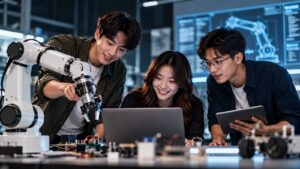
You need engineers to design its body, motors and electronic components. You need IT specialists to develop software that controls its movements. Add AI, and suddenly, that robot can recognise objects, learn patterns and respond to its surroundings.
Pretty amazing what happens when different fields work together, isn’t it?
The same thing happens in everyday life.
Your smartphone combines electronic engineering, software development and AI. Modern cars use sensors, computer systems and intelligent technologies to assist drivers. Even shopping malls and office buildings are becoming smarter, using connected systems to manage lighting, security and energy consumption.
Think about contactless payments, too. A simple tap involves electronic hardware, secure communication networks and software processing transactions in seconds.
What looks effortless to us often involves different technologies working seamlessly behind the scenes.
These innovations show us that Engineering and IT are no longer separate worlds. They are two sides of the same technological transformation.
One creates the possibilities. The other helps bring them to life.
AI is changing the game for engineers
When you hear AI, you probably think of ChatGPT, image generators or virtual assistants.
But AI is doing much more than answering questions or creating content.
Imagine an engineer designing a new car. Traditionally, testing different designs could take considerable time and resources. Today, AI-assisted tools can help explore design options, simulate performance and identify potential improvements before a physical prototype is built.
Or picture a factory where machines can signal that something might go wrong before they actually break down.
AI can suggest solutions, but it still takes human knowledge, creativity and judgement to determine whether those solutions are safe, practical and effective.
AI doesn’t make engineering knowledge less important. It makes knowing how to use that knowledge even more valuable.
When technology meets creativity, possibilities grow
Here’s something people sometimes overlook: Engineering and IT aren’t just about calculations, machines and computer screens.
They’re also about creativity.
Think about someone designing a prosthetic hand that responds to muscle signals. Engineers develop its physical structure and electronics, programmers create the control software, and AI may help interpret signals to produce more natural movements.
Or imagine a smart farming system that monitors soil moisture and automatically waters crops when necessary.
Engineering provides the sensors and irrigation equipment. IT connects the devices and manages the information. Intelligent software helps determine when water is needed.
These are not just impressive inventions. They are examples of technology solving problems that affect real people.
And that is where creativity becomes important.
The best solutions often begin with a simple question: What if there were a better way to do this?
For students who enjoy experimenting, asking questions or finding ways to improve everyday experiences, combining Engineering and IT can provide exciting opportunities to turn ideas into something useful.
So, what does this mean for you?
If you’re a student thinking about your future, here’s something worth considering.
You don’t necessarily have to choose between being interested in engineering and being passionate about technology.
Love building things but also enjoy coding? Robotics and automation could bring both interests together.
Interested in sustainability and the environment? Smart energy systems combine engineering, data and technology to help reduce energy waste.
Fascinated by how self-driving cars work? That’s mechanical engineering, electronics, programming and AI coming together.
Maybe you enjoy gaming and wonder how virtual environments interact with physical movements. Or perhaps you’re interested in healthcare and want to develop technology that helps people live more independently.
The possibilities go far beyond traditional job titles.
And here’s the interesting part: you don’t need to be an expert in everything.
An engineering student who understands basic programming may be able to automate repetitive tasks or analyse data more effectively.
An IT student who understands how physical machines operate may be better equipped to develop software for robotics, manufacturing or smart devices.
Sometimes, learning just a little outside your main field can change how you approach a problem entirely.
The skills that could make you stand out
Let’s say two engineering graduates apply for the same job.
Both understand engineering principles. Both have the necessary qualifications.
But one has also learned how to use data analytics, basic programming and AI tools to solve engineering problems.
Who might have an additional advantage?
Employers increasingly value people who can adapt, solve problems and work confidently with emerging technologies.
According to the World Economic Forum’s Future of Jobs Report 2025, AI and big data, cybersecurity and technological literacy are among the fastest-growing skill areas.
This highlights why digital skills are becoming relevant across many professions, not just traditional IT roles.
But technical knowledge is only part of the picture.
Creativity, communication, teamwork and critical thinking matter too.
After all, developing a smart city, building an intelligent machine or designing a new medical device requires people from different backgrounds to work together.
An engineer may understand the physical design, while a programmer understands the software. A data specialist may identify patterns that help both improve the final product.
Being able to understand different perspectives and connect ideas can be just as valuable as knowing how to operate the latest technology.
Will AI take away your future job?
It’s a question many students are asking.
If AI can write code, generate designs and analyse information, what will be left for humans to do?
Think of AI as a powerful assistant.
It can help you work faster, explore possibilities and handle repetitive tasks. But it doesn’t automatically understand every real-world situation, and its answers aren’t always correct.
An AI-generated design still needs an engineer to check whether it’s safe. AI-generated software still needs developers to test whether it works properly.
And when something unexpected happens, human judgement becomes essential.
AI may change the way certain jobs are performed, and some tasks will become more automated. At the same time, new responsibilities and opportunities may emerge as organisations adopt these technologies.
Rather than worrying only about what AI can do, a more useful question might be:
How can I learn to use AI to become better at what I do?
That’s the mindset that can help students prepare for a changing workplace.
Your future doesn’t have to fit into one box
You might start your journey studying engineering and discover a passion for programming.
Or you might begin with IT and become fascinated by robotics, automation or intelligent machines.
That’s perfectly fine.
The world is changing too quickly for every career to follow one fixed path.
What matters is building strong foundations, staying curious and being willing to learn new skills.
And you don’t have to wait until you graduate to begin.
Try coding a simple programme. Experiment with an electronic project. Explore how AI tools work. Join a robotics competition or collaborate with classmates who have different interests.
Even a small project, such as creating an automatic plant-watering system or developing a simple app that monitors electricity usage, can teach you how engineering and IT complement each other.
More importantly, these experiences help you discover what you genuinely enjoy.
You never know which project, challenge or unexpected interest might spark your next big idea.
The future is about connecting the dots
Engineering gives us the ability to build. IT allows us to connect. AI helps us make things smarter.
But the real magic happens when people bring these ideas together.
The next breakthrough might come from an engineer who learns to code, an IT graduate who understands robotics, or a student who sees a connection that others have missed.
As technology continues to evolve, the ability to learn, adapt and work across disciplines will become increasingly valuable.
So, whether you’re drawn to Engineering, IT or AI, remember that your interests don’t have to compete with one another.
They might just be the perfect combination.
Because the future isn’t about choosing between Engineering and IT. It’s about discovering what you can achieve when you bring them together.
About the Writer
Thinesh Kumar is a Mechanical Engineering graduate from Universiti Tenaga Nasional (UNITEN) and a registered Graduate Engineer and Inspector of Works with the Board of Engineers Malaysia (BEM). Over the course of his engineering career, he was involved in major infrastructure and commercial developments, including the Klang Valley Mass Rapid Transit (KVMRT) project and TRX Lifestyle Mall, gaining hands-on experience in M&E systems, technical coordination and the challenges of delivering complex projects.
Now a Relationship Manager at Brickfields Asia College (BAC), Thinesh brings together his engineering background and experience in education to explore the growing relationship between engineering and information technology. He is particularly interested in how programming, automation and digital solutions can complement engineering expertise, reshape traditional workflows and create new opportunities for the next generation of professionals.